Dekstr — find the money your ads are burning, then publish what wins it back.
Connect your ad, analytics, payment and store accounts once. Dekstr reads them every day, finds what is burning budget or sitting invisible in search, and writes it up in a Monday brief. Then it helps you write the posts, waits for your approval on every channel, publishes them and measures what they did.
Built for SaaS and e-commerce teams spending $2,000–50,000 a month on ads — and posting every week.
No credit card. We'll email you when your spot opens.
Dekstr is reconciling last night's spend against last night's revenue, currency by currency
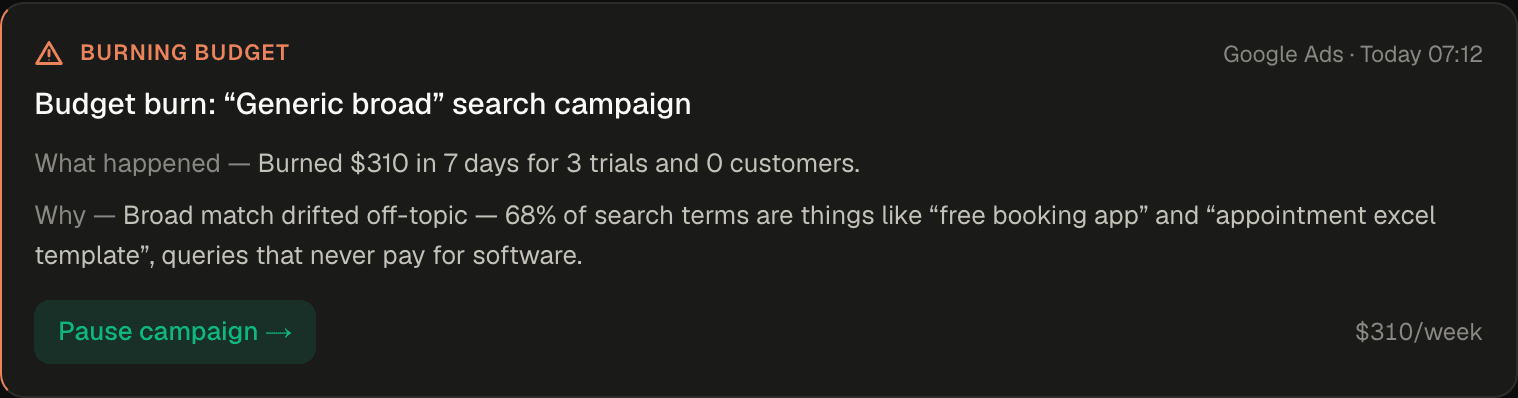
What happened — Burned $310 in 7 days for 3 trials and 0 customers.
Why — Broad match drifted off-topic — 68% of search terms are things like “free booking app” and “appointment excel template”, queries that never pay for software.
What Dekstr is
Dekstr is a growth analytics and content application for SaaS and e-commerce teams. With read-only access it connects to the ad, analytics, payment and store accounts you already use — Google Ads, Google Analytics 4, Google Search Console, Stripe, iyzico, PayTR, Shopify, Trendyol and n11 — reconciles what you spent against what you earned, and every Monday at 09:30 Istanbul time emails you a brief: where the budget went to waste, where you are invisible in search, and what to do this week. The same workspace runs your social content too: you write the posts in Dekstr, approve each one on the channel it goes out on, Dekstr publishes the approved ones to your own Instagram account and then measures what they did.
How it works
- 01
Connect
One Google sign-in for Ads, Analytics and Search Console; one API key for each store and payment provider. Two minutes each — no CSV, no tracking script to install.
- 02
Monday 09:30 Istanbul: the brief
Every night Dekstr reconciles spend against sessions, search queries and revenue, then runs four rules over the result. Monday morning it emails you the week: what happened, why, and a short action list — at most four, each tied to a finding.
- 03
Write it, approve it, publish it
Turn a finding into posts in your own voice, approve each one on the channel it goes out on, and Dekstr publishes to your Instagram account at the minute you set — then measures what it did. Nothing goes out that a human did not approve.
On pricing: a growth lead reads your numbers once a month and costs you a salary. Dekstr reads them every morning for a fraction of one — beta pricing lands there.
1 · Measure and find the waste
The campaign deck watches every line of spend
A deck is the live set of cards Dekstr keeps on one subject — here, every line of your spend and every query you show up for. Four rules run on your own numbers each night: a campaign that spent without a sale, sessions that never became a signup, search terms you appear on but nobody clicks, pages stuck on page two. Each finding arrives as what happened → why → what to do, with what it is worth per week.
1 · Measure and find the waste
A weekly brief your Monday can act on
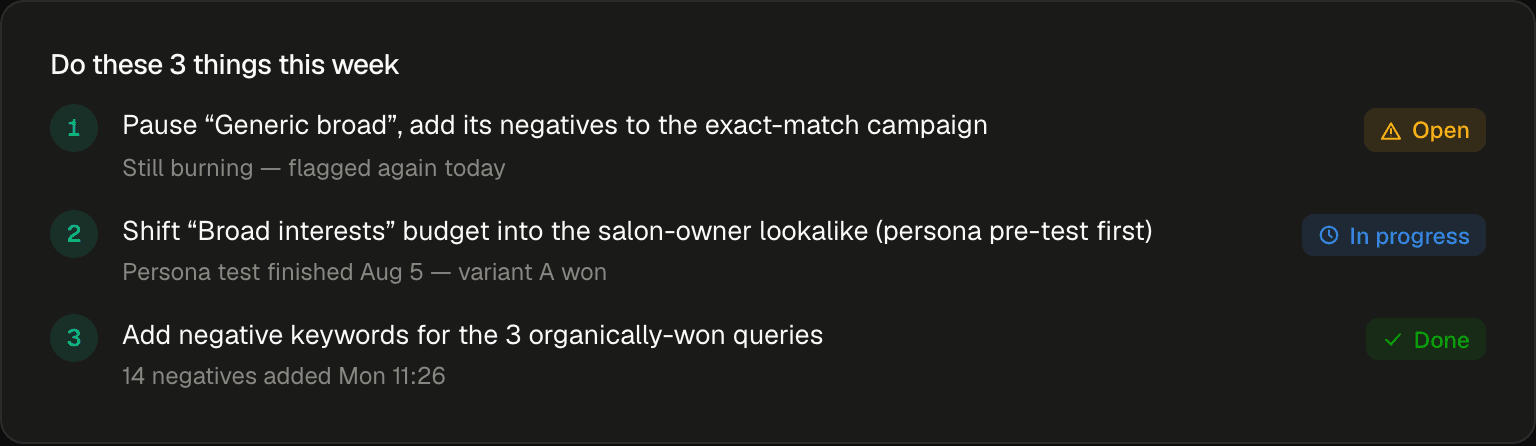
Every Monday at 09:30 Istanbul time, by email: a TL;DR, the week's findings and a short action list — at most four, each tied to a finding. Nothing that wasn't measured gets a number.
2 · Produce, approve, publish, measure
The content deck: write it, approve it, publish it, measure it
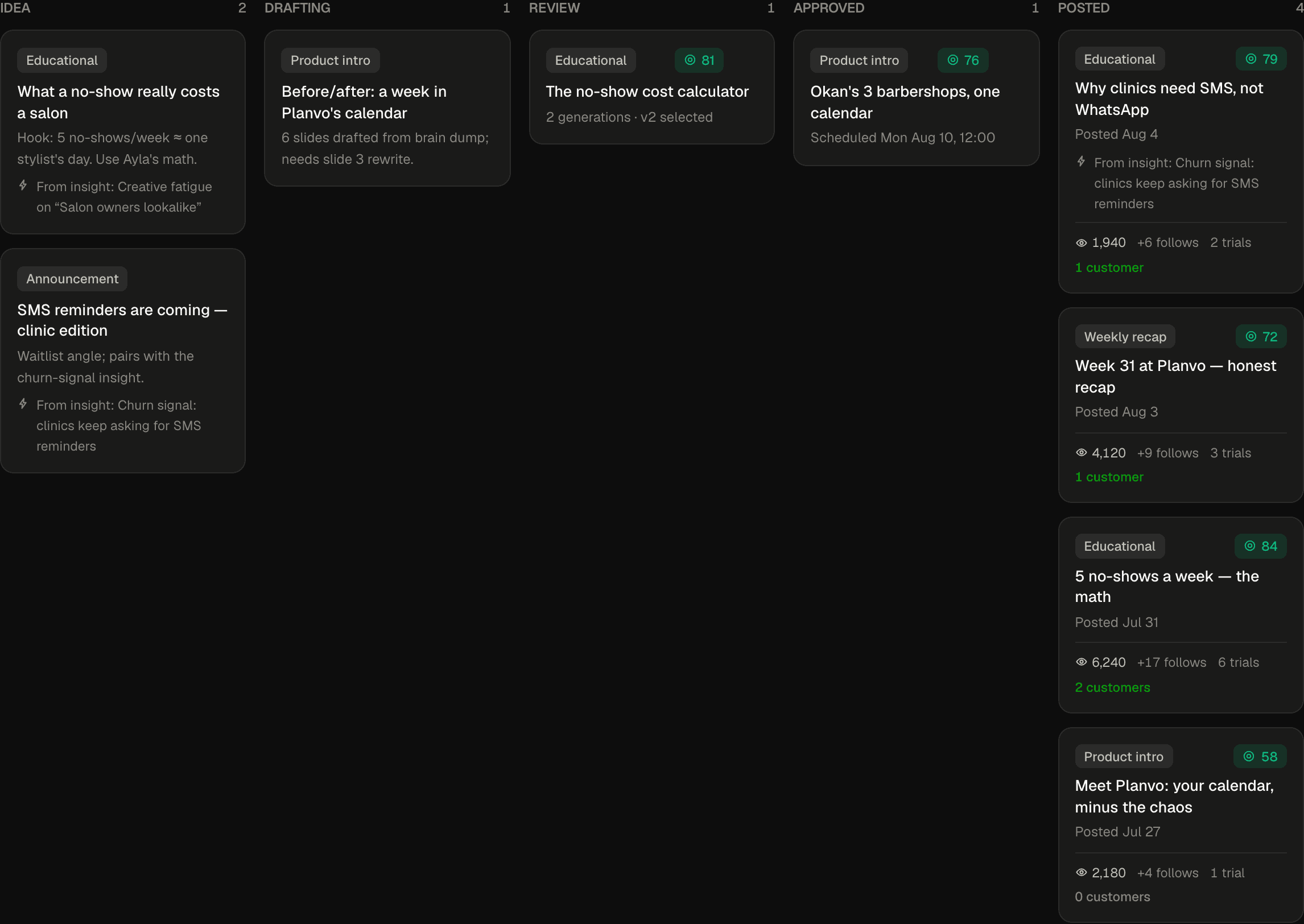
Write posts from a brief in your own voice — two languages side by side, no invented numbers — and watch them move across the board. Approval is per channel: the same post can go to two accounts with two captions and you approve each one. Dekstr publishes the approved rows to your own Instagram account at the scheduled minute, and a row that missed its slot is flagged late instead of quietly going out two days later. Once it is out, the same card carries what it did.
All your sources, one brain
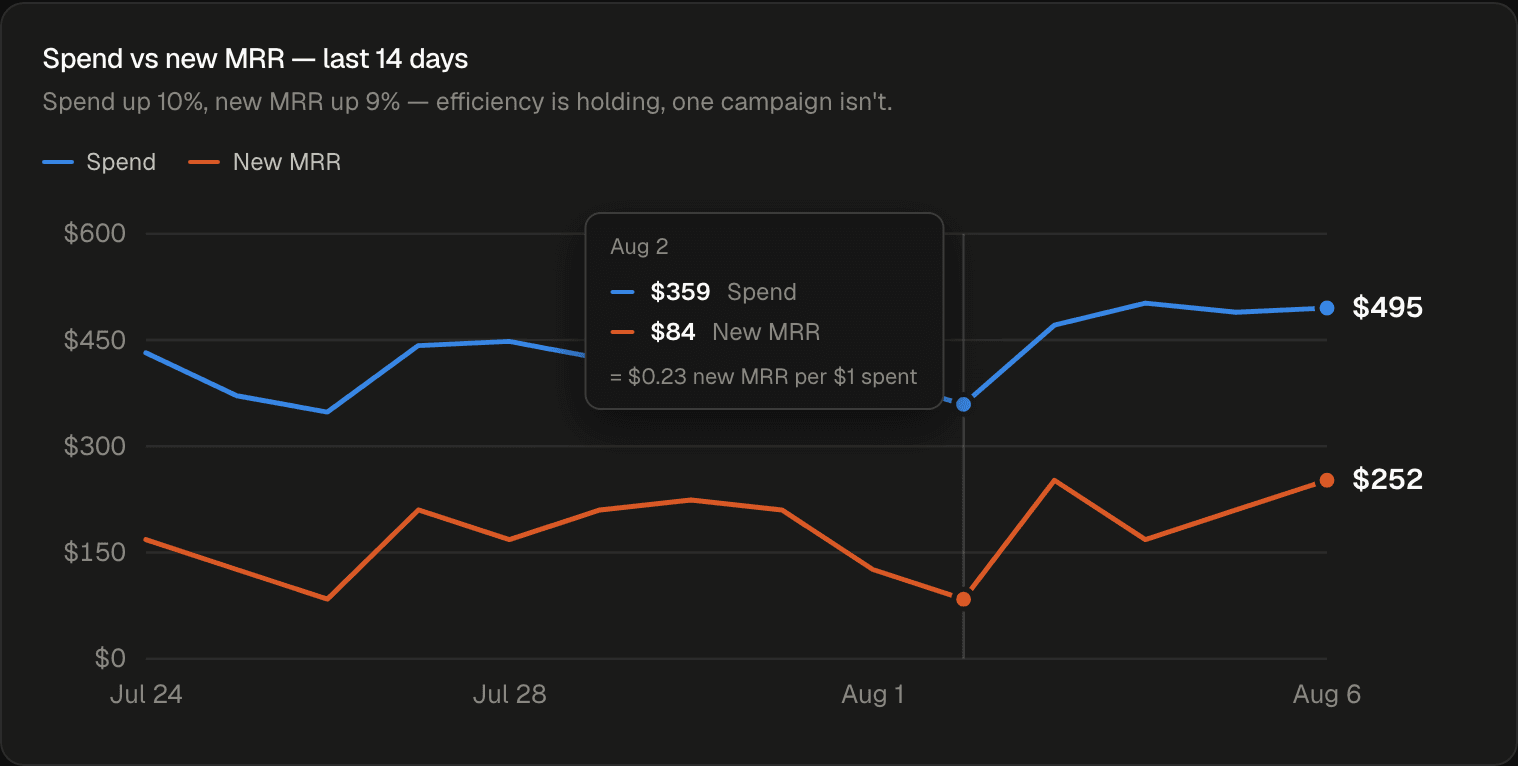
One Google sign-in, one key per store and payment provider. Ads, analytics, payments, marketplaces and your Instagram account are read, normalized into one week and interpreted together — revenue stays in the currency it came in and spend in the currency it was spent, because Dekstr never adds two currencies to make a bigger number. You never export a CSV again.
The part we measured and did not like
The persona deck, and the number we published about it
The persona deck builds a panel from your own customers and scores each creative before you spend — every verdict carries the objection behind it, not just a number. We then tested the panel in its weakest form (uncalibrated, built from a declaration alone) against a yardstick we do not control: how long a competitor's ad stayed live in Meta's Ad Library. 150 pairs, and the panel got 46.7% right (95% CI 39–55) — the same 46.7% as a single LLM with no panel at all, against 50% for a coin toss. So it did not pick winners, and we published that. It is the reason the panel calibrates against your real results instead of a score we invented, and the reason we keep measuring.
Read the whole measurement →What Dekstr can and cannot do with your accounts
- Read-only on every analytics, ad and revenue source. Dekstr reads sessions, search queries, campaigns, spend, orders and payments, and keeps revenue as daily totals — no buyer names, addresses or card details.
- Dekstr never changes your ad accounts. It never creates, pauses or edits a campaign or budget — it recommends, you make the change yourself and mark it done.
- Dekstr publishes only what you approve. It posts to your Instagram account only after a person approved that exact post for that exact account. Nothing goes out on its own, and a post that missed its time is flagged late rather than published late.
- Disconnect any source in one click. Access tokens and API keys are encrypted at rest, and disconnecting deletes them.
Which Google data Dekstr requests, and why
- Google Ads (adwords) — reads campaigns, spend, clicks and conversions, so Dekstr can show where the budget went and what it returned.
- Google Analytics 4 (analytics.readonly) — reads sessions and key events by channel, so paid traffic can be reconciled with what actually happened on the site.
- Search Console (webmasters.readonly) — reads search queries, pages and rankings, so organic demand can be compared with what you are paying for.
Dekstr's use and transfer to any other app of information received from Google APIs will adhere to the Google API Services User Data Policy, including the Limited Use requirements. This data is never sold, never used for advertising and never used to train AI models; summaries of it are sent to Anthropic's Claude only to write your own brief and audience panel. Read the privacy policy
See it running before you decide
The demo runs on a full fictional company — every number reconciles, from the daily series down to each campaign, and the content board is in there too. No sign-up, no sales call.
See the demo →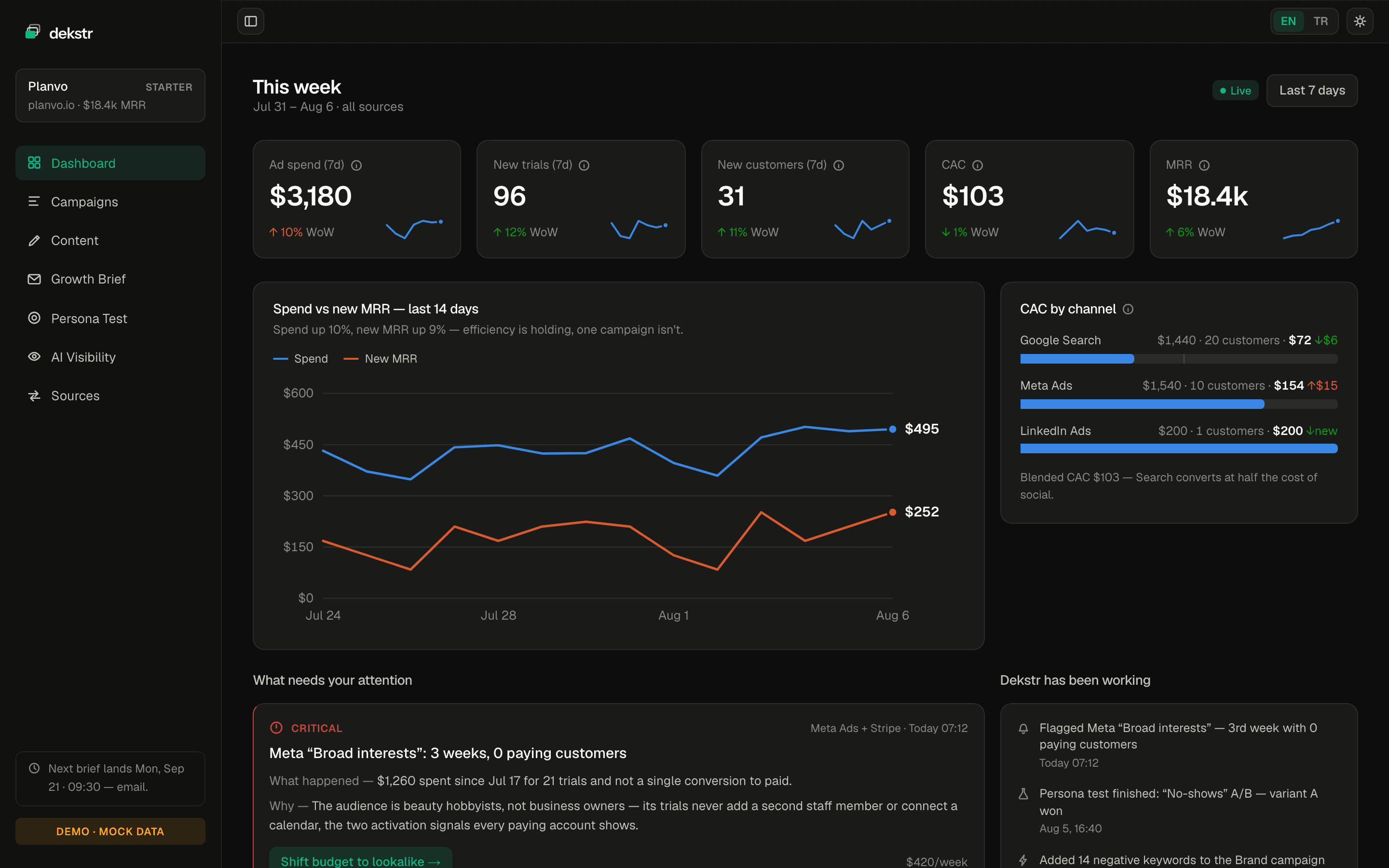
Where Dekstr stands today
Planvo is the fictional company we built for the demo — the $430 comes from it, not from a customer. Every number inside the demo reconciles across it, from the daily series down to each campaign.